
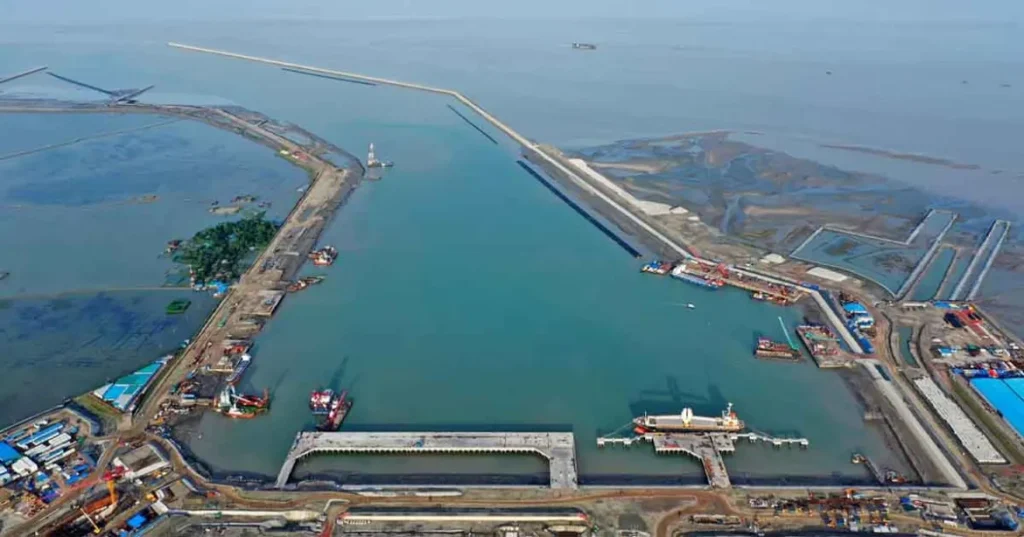
For decades, the maritime logistics spine of Bangladesh has been anchored heavily around the port of Chattogram. While Chattogram remains the lifeblood of the nation’s trade, its draft limitations and heavy congestion have historically capped vessel sizes, forcing operators to rely on lightering operations at outer anchorages like Kutubdia. However, the emergence of deep-water gateways at Payra and Matarbari is fundamentally reshaping how shipowners, operators, and charterers approach deployment, cargo capacity, and port turnaround times in the region.
1. Breaking the Draft Bottleneck
The single biggest operational shift introduced by Matarbari and Payra is the accommodation of deep-draft vessels. Traditionally, vessels drawing over 11.5 meters had to undergo extensive mid-lightering before they could safely berth.
- Matarbari’s deep-water coal terminal and multi-purpose facilities have proven that vessels with significantly deeper drafts can call directly without waiting for tidal windows or enduring prolonged lightering delays.
- For owners of Panamax and Capesize bulk carriers, this translates to maximized deadweight utilization per voyage, drastically cutting down the cost-per-ton metrics that plague shallow-port logistics.
2. Streamlining Supply Chains and Cutting Demurrage Risks
Time is capital in dry bulk and container shipping. In conventional Bangladeshi ports, congestion at berth and outer anchorage bottlenecks frequently trigger lengthy laytime disputes and demurrage claims.
- The modern infrastructure at these newer gateways offers faster discharge rates, efficient grab-discharge systems, and state-of-the-art port handling equipment.
- By reducing port turnaround times, owners and charterers face fewer risks of sailing deadlines being missed, keeping fixture schedules tight and predictable.
3. Redefining Regional Transshipment and Feeder Economics
The operational capacity of Matarbari and Payra extends beyond domestic import-export handling; it positions Bangladesh as a viable regional hub.
- Instead of relying exclusively on regional transshipment ports in Colombo or Singapore for mega-container lines or heavy-lift parcels, direct deep-water access allows larger feeder networks to service the Bay of Bengal efficiently.
- This reduces the reliance on complex coastal feeder legs, lowering the administrative and operational overheads for operators managing multi-port itineraries in the region.
4. What This Means for Owners and Charterers Moving Forward
As these ports scale up their infrastructure, shipowners and charterers must recalibrate their operational strategies:
- Fixture Planning: Charterers can now contract larger tonnage parcels into Bangladesh without factoring in the severe draft penalties historically associated with regional berths.
- Vessel Vetting: Technical superintendents and operators vetting vessels for Bangladesh-bound voyages must update their risk matrices, keeping in mind the improved pilotage, modern navigation aids, and specific safety protocols enforced at these new terminals.
- Claims and Disputing: With clearer operational timelines and modern terminal data available, the nature of Statement of Facts (SOF) and demurrage calculations is becoming more transparent, minimizing friction between owners and charterers.
Payra and Matarbari are no longer just future prospects—they are active components of Bangladesh’s maritime blueprint. For owners willing to adapt their tonnage profiles to leverage these deep-water gateways, the reward is unmatched efficiency, higher cargo payloads, and a decisive competitive edge in the Bay of Bengal.